
Construction Staking Survey Steps That Keep Subdivision Work on Plan
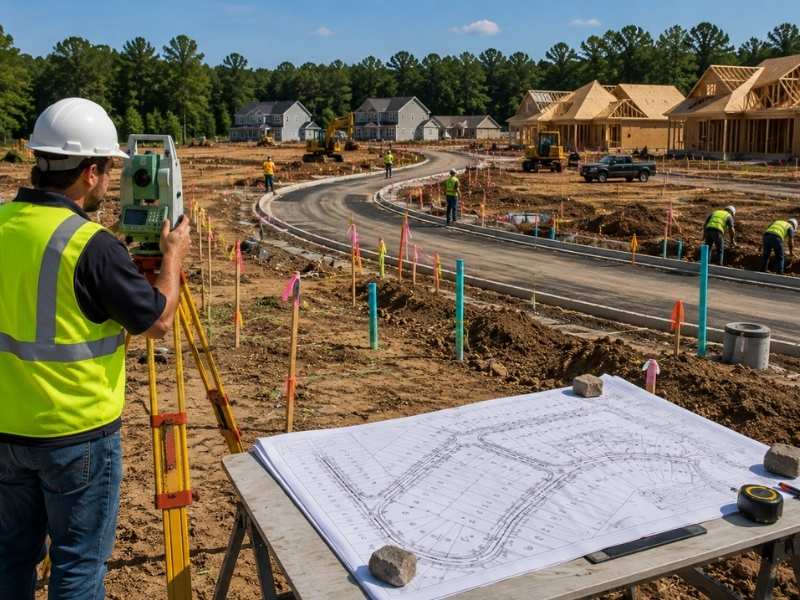
A construction staking survey does more work on a subdivision than it does on one house lot. It has to guide roads, water lines, and dozens of separate lots at once. None of those lines can cross. No crew can step on another crew’s work.
What Does a Construction Staking Survey Do on a Subdivision?
A single house needs a few stakes. A subdivision needs a full system. Roads have to line up with the plat. Pipes have to run under the right spots. Each lot needs its own corners marked. That way, a builder knows exactly where their land starts and stops. A construction staking survey ties all of that into one plan every crew can follow.
That plan starts long before any digging happens. Surveyors study the approved plat and the site plan first. Those papers show where every road, pipe, and lot line is supposed to sit. The survey turns that paper plan into real marks on real ground, so nobody on site has to guess.
Staking Roads, Pipes, and Lot Corners Together
Roads get staked first in most subdivisions. Everything else gets measured from them. Once the road lines are set, surveyors mark the pipe lines next. These show where water, sewer, and power lines will run under the ground. Only after that work is done do a lot of corners get staked. That gives each builder a clear line for their own piece of land.
This order matters a lot. A road staked in the wrong spot throws off every lot measured from it. A pipe line marked before the road grade is set can end up too deep or too shallow. Getting the order right the first time keeps the whole subdivision on the same solid base.
Crews on site rely on these stakes daily. A grading crew checks them before shaping the road bed. A pipe crew checks them before digging a trench. A framing crew checks a lot of corners before setting the first form board. Without clear stakes, each of those crews would be working off a rough guess instead of a real measurement.
Staking Moves in Stages as Sections Open Up
A subdivision rarely gets built all at once. Builders often open small sections at a time. A few lots go up for building while later sections still sit in planning. Each new section needs its own staking round. The surveyor has to stretch the road and pipe layout into the new lots, and the lines still have to match up.
This staged work means surveyors return to the site more than once, sometimes months apart. Ground can shift during an early section. Lot lines can change slightly during final approval. Either one can throw off a later section if nobody checks first. Checking the stakes at the start of each new section keeps the whole subdivision lined up from the first lot to the last.
Weather and heavy equipment add to the challenge. Rain can wash out a marker in an unfinished section. A grading crew moving dirt for a later phase can bury a stake meant for an earlier one. Surveyors expect this and plan return visits around it, rather than assuming the first round of stakes will last through the whole build.
Multiple Builders, One Shared Set of Stakes
A subdivision often has more than one builder working different lots at the same time. That makes shared, correct staking data even more important than it would be on a single project. Two crews working close together both need to trust the same set of marks.
Surveyors usually share staking data with the developer. The developer passes it along to each builder as lots get assigned. If a builder spots a stake that looks off, whether from heavy equipment or a question about a lot line, they should report it fast. That keeps one crew’s mistake from turning into a fight between two builders. Shared trust in the data keeps a subdivision moving without friction.
Clear communication also helps when one builder finishes a lot ahead of schedule and another falls behind. A surveyor who knows the full picture can flag which lots are ready for final staking checks and which ones still need to wait on earlier site work. That kind of coordination keeps the whole tract moving together instead of one builder’s delay slowing down everyone else.
Good Survey Work Keeps Small Errors from Spreading
Errors on a subdivision tend to spread. A mistake in the road or pipe layout can touch every lot that depends on it. A construction staking survey done right at the start stops that kind of ripple before it begins.
Catching a bad road stake early takes a quick field check. Catching it after several lots are already graded costs much more. Crews have to redo work on every one of those lots. Subdivisions that stay on schedule are the ones where staking gets checked at each new section, not just once at the start.
Good staking also protects the budget, not just the schedule. Rework on a subdivision rarely stays small. If a pipe line was set too shallow across a whole section, fixing it means reopening trenches on every lot along that line. A quick check before the pipe crew moves in costs far less than that kind of large scale repair.
Frequently Asked Questions
What makes staking different on a subdivision compared to a single lot?
A subdivision needs a full system of stakes covering roads, pipes, and dozens of lots, not just one set of marks for one building. Every lot gets measured off the same shared road and pipe layout.
How are stakes coordinated across multiple lots?
Roads get staked first, since every other measurement starts from them. Pipe lines follow, then lot corners. This order keeps every lot lined up with the same shared reference points.
Who relies on subdivision staking data?
The developer, the pipe crews, and every builder working a lot on the tract all use the same set of marks. Since the road and pipe layout affects every parcel, one shared source of data keeps everyone aligned.
Why do developers open subdivision sections in stages?
Developers open sections to match building demand, money, and permits. Staking each new section on its own lets the surveyor stretch the road and pipe layout into new lots without losing the match to the sections already built.