
How Drone LiDAR Mapping Prevents Drainage Surprises
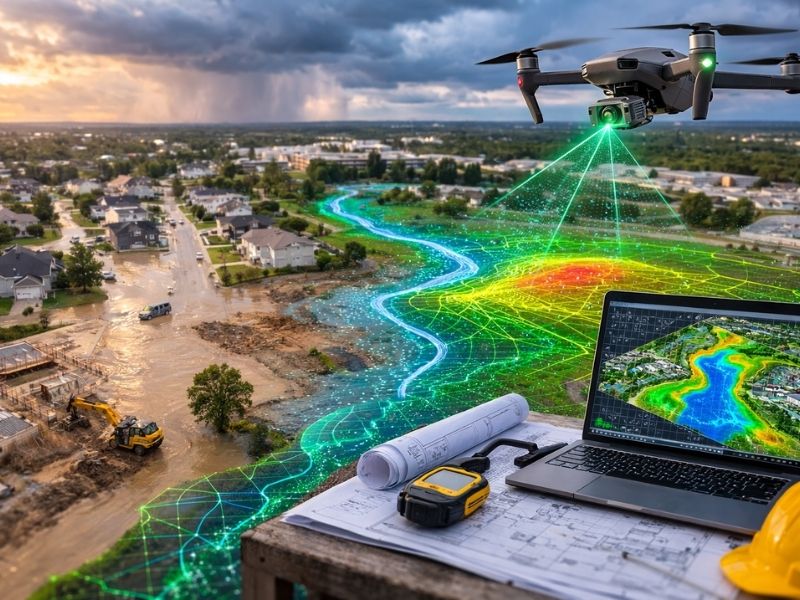
A site can look completely flat and still send water straight into a foundation. That’s the problem most developers don’t see until it’s too late. Drone LiDAR mapping gives you the elevation data to see it before grading starts, before permits are submitted, and before money gets wasted fixing something that should have been caught on day one.
What Drone LiDAR Mapping Actually Does
Most people have heard of LiDAR. Few understand what it actually produces.
A drone fitted with a LiDAR sensor flies over the property and fires millions of laser pulses at the ground. Each pulse bounces back. The system records how long it takes and calculates the exact distance to the surface. Do that millions of times across a site and you get a point cloud: a dense, three-dimensional picture of the terrain.
How the Technology Works
The drone collects data fast. A site that would take a ground crew days to survey manually can be covered in hours. The laser pulses also pass through gaps in grass and low vegetation, so the ground surface gets captured accurately even when the site isn’t fully cleared.
Vertical accuracy typically lands between 2 and 5 centimeters for drone-based systems. That level of detail matters on flat land where a 10-centimeter depression can hold standing water for days after a storm.
What the Data Looks Like
The raw point cloud gets processed into a Digital Elevation Model, or DEM. That’s a gridded surface map showing every high point and low point across the property. Contour lines get generated from it. Drainage flow paths get calculated. Engineers and site designers can load the file directly into their software and start working.
The deliverable is actual usable data, not a rough approximation.
Why Drainage Problems Catch Developers Off Guard
Drainage failures aren’t random. They follow the terrain. The problem is that terrain isn’t always obvious by looking at it.
The Flat Site Problem
Flat sites feel safe. No steep slopes, no obvious runoff paths, nothing that looks like a drainage concern during a walkthrough. That confidence is where projects run into trouble.
On flat land, small elevation differences control everything. A 15-centimeter depression in the wrong spot becomes a pond after a heavy rain. A subtle grade running toward a building pad means water sits at the foundation instead of draining away. These aren’t things you can eyeball. You need measured data to see them.
What Traditional Methods Miss
Older survey methods collect elevation points manually. A crew walks the site and records spot elevations at intervals. The problem is that intervals miss things. A depression between two survey points doesn’t show up in the data. A subtle drainage swale running diagonally across the property gets skipped.
Drone LiDAR mapping collects hundreds of points per square meter. Nothing gets skipped.
How Drone LiDAR Mapping Catches Drainage Issues Early
Reading Flow Paths Before Grading Starts
Once the DEM is processed, engineers can run flow path analysis on the data. The software traces where water would travel across the surface under different rainfall scenarios. That shows whether runoff moves away from structures, whether it concentrates in problem areas, and whether existing drainage infrastructure can handle the volume.
Finding a flow path problem in a site model costs nothing to fix. Finding it after grading is done costs significantly more.
Spotting Low Spots and Depression Zones
LiDAR data makes depressions visible. Any area where water would collect shows up clearly in the elevation model. Developers can see these zones before a design gets finalized and adjust grading plans to route water away from them.
On a site without that data, the first sign of a depression is often standing water after the first rainstorm post-construction.
Comparing Before and After Conditions
Drone LiDAR mapping can capture the site before any work begins. That pre-construction baseline becomes a reference point. Once grading is done, a second flight confirms that the finished surface matches the drainage design. If something shifted during grading, the comparison catches it before it causes a problem.
Some permitting authorities now ask for this kind of documentation as part of the approval process.
What Developers Can Do With the Data
Feeding It Into Drainage Design
Civil engineers and site designers can take the DEM directly into hydraulic modeling software. Programs like HEC-RAS use the elevation data to simulate how water moves across the site. That simulation shows whether the drainage design works before anything gets built.
It’s the difference between designing on real terrain data and designing on assumptions.
Using It for Permit Documentation
Many permit applications require a drainage plan supported by accurate elevation data. A drone LiDAR survey produces the documentation needed to satisfy those requirements. Having it ready early keeps the permit process moving instead of stalling while a survey gets ordered.
When to Order a Drone LiDAR Survey
Order it before site design is finalized. The earlier the data comes in, the more flexibility the design team has to work around drainage concerns.
Waiting until the grading plan is done means any changes discovered during the survey have to work backward through the design. That takes time and costs money.
The ideal sequence is: LiDAR survey, then drainage design, then grading plan, then permits. Not the other way around.
Frequently Asked Questions
How accurate is drone LiDAR mapping for drainage work?
Drone LiDAR systems typically produce vertical accuracy between 2 and 5 centimeters. That’s precise enough to identify drainage depressions, map flow paths, and build elevation models that engineers can use for hydraulic design and permit documentation.
Is drone LiDAR mapping different from a standard topographic survey?
Yes. A standard topographic survey collects elevation points manually at set intervals. Drone LiDAR collects hundreds of data points per square meter across the entire site. The result is a much denser and more complete picture of the terrain, especially useful for identifying subtle drainage issues on flat land.
How long does a drone LiDAR survey take?
Most development sites can be flown in a few hours. Data processing and delivery of the final DEM typically takes 3 to 7 business days depending on site size and the level of detail required.
Can drone LiDAR data be used for permit applications?
Yes. The elevation models and drainage documentation produced from a drone LiDAR survey can support permit applications that require site drainage plans or grading documentation. Confirm specific requirements with the local permitting authority before submitting.
What size site is drone LiDAR mapping best suited for?
Drone LiDAR works well on sites ranging from a single acre to several hundred acres. Smaller sites may also be candidates for ground-based survey methods depending on budget and data requirements. A licensed surveyor can recommend the right approach based on the project scope.