
↓
 

Daphne Land Surveying

...a Brandon Bailey, PLS website.

Daphne Land Surveying - Brandon Bailey header
Daphne Land Surveying
  • Home
  • Land Surveying
  • ALTA Title Survey
  • Boundary Survey
  • Construction Survey
  • Drone LiDAR Mapping
  • Lot Survey
  • Elevation Certificate | Flood Survey
  • Flood Survey
  • Blog
  • Contact Us
Home - Page 2 << 1 2 3 4 … 8 9 >>

Post navigation

← Older posts
Newer posts →

LiDAR Mapping for Flood Zone Analysis: A Developer’s Practical Guide

Daphne Land Surveying Posted on May 20, 2026 by AdminDaphneLSMay 15, 2026
Drone performing LiDAR mapping over a development site with elevation data and terrain visualization for flood zone analysis

Floods don’t care about property values. They follow elevation. And if your site data is wrong by even half a meter, your flood model is wrong too.

That’s the core problem with traditional surveys over large parcels. They’re slow, expensive, and can miss subtle terrain features that determine where water goes. LiDAR fixes that. It gives you dense, accurate elevation data across wide areas, fast. For developers doing flood zone analysis, it’s now the baseline standard, not a premium option.

Here’s what you need to know to use it properly.

What Is LiDAR, and Why Does It Matter for Flood Analysis?

LiDAR mapping works by firing millions of laser pulses at the ground from an aircraft or drone. Each pulse bounces back. The system records the return time and calculates the exact distance to the surface. LiDAR stands for Light Detection and Ranging. An aircraft or drone fires millions of laser pulses at the ground. Each pulse bounces back. The system records the return time and calculates the exact distance to the surface.

The output is a point cloud: a dense 3D map made of hundreds of millions of individual data points. Each point has an X coordinate, a Y coordinate, and a Z coordinate (elevation).

For flood analysis, elevation is the variable that matters most. A 20-centimeter error in a DEM can shift a flood boundary by hundreds of meters on flat terrain. LiDAR reduces that error to 10 centimeters or better under standard airborne conditions.

How LiDAR Data Gets Used in Flood Modeling

Step 1: Point Cloud to Digital Elevation Model (DEM)

Raw point clouds are processed into a Digital Elevation Model. A DEM strips out trees, buildings, and vehicles using classification algorithms. What’s left is a bare-earth surface.

That bare-earth grid feeds directly into hydraulic simulation software. Programs like HEC-RAS, TUFLOW, and MIKE FLOOD use DEMs to predict where water flows, how deep it gets, and how long it sits.

The finer the DEM resolution, the better the flood model. A 1-meter DEM is solid for most site-level work. A 25-centimeter DEM is better for drainage infrastructure design.

Step 2: Identifying Flow Paths and Problem Areas

LiDAR reveals what standard topo maps can’t: subtle depressions, natural drainage channels, and culvert inlets. Water always follows the lowest path. LiDAR makes those paths visible before construction starts.

A site that looks flat on a 5-meter contour map might have a 40-centimeter drainage swale running through it. That changes your grading plan entirely.

Step 3: Pre- vs. Post-Development Comparison

Developers use LiDAR-based models to compare existing versus proposed conditions. If you add 8,000 square meters of impervious surface (rooftops, paving, car parks), runoff volume increases. LiDAR lets engineers model exactly where that extra water goes before a single trench is dug.

Regulatory bodies in many jurisdictions now require this comparison as part of the planning approval process.
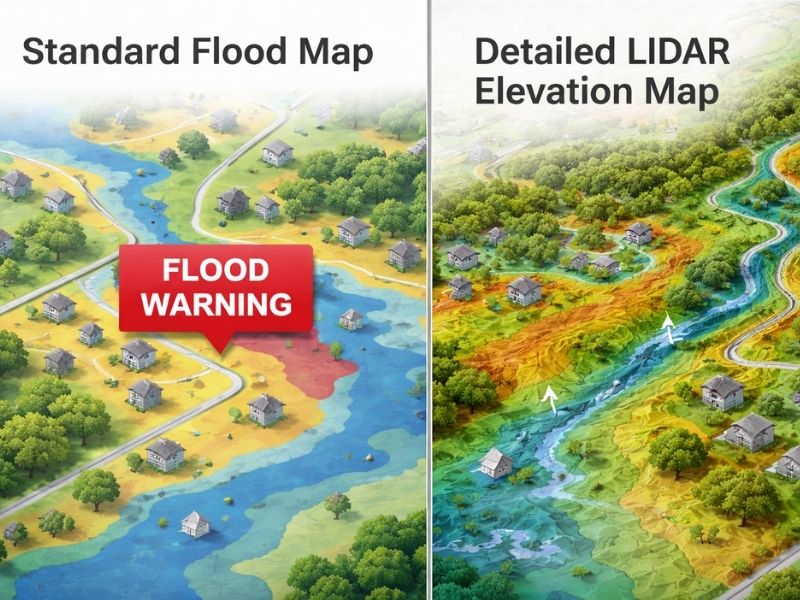
LiDAR mapping comparison showing a standard flood map beside a detailed elevation map with terrain and water flow analysis

LiDAR vs. Other Survey Methods

Airborne LiDAR is the workhorse for regional flood analysis. It covers hundreds of square kilometers per day with a vertical accuracy of 10 to 15 centimeters. That’s fast enough and precise enough for most flood modeling work across large parcels or catchment areas.

Drone LiDAR trades coverage for detail. It covers 1 to 5 square kilometers per day, but accuracy tightens to 2 to 5 centimeters. That level of resolution works well for site-level drainage design where small elevation differences actually matter.

Ground surveys are the slowest option at 5 to 10 hectares per day. The tradeoff is sub-centimeter accuracy. Use them for small areas, legal boundary work, or to verify benchmarks that other methods flagged as uncertain.

Photogrammetry sits in a different category. It’s fast and works from aircraft or drones, but accuracy drops under tree canopy. Expect 5 to 15 centimeters on open terrain. Avoid it where dense vegetation covers the site.

For broad flood zone analysis, airborne LiDAR is the right starting point. For detailed drainage design at the site level, drone LiDAR or a targeted ground survey fills the gaps.

Where to Get LiDAR Data

You don’t always need to commission a new survey. Many governments publish open LiDAR datasets:

  • United States: USGS 3DEP (3D Elevation Program) covers most of the country with 1-meter resolution data. Access it at apps.nationalmap.gov.
  • United Kingdom: The Environment Agency publishes 1-meter and 25-centimeter LiDAR for most of England at no cost.
  • Australia: Geoscience Australia’s ELVIS platform provides elevation data for large parts of the country.
  • European Union: The Copernicus Land Monitoring Service offers 10-meter and 25-meter DEMs across Europe.

Check two things before downloading: collection date and point density. Data collected before major development or after a significant flood event may not reflect current ground conditions. Aim for data collected within the last 3 to 5 years for active development sites.

What Developers Should Ask Before Using LiDAR Data

Before your engineer submits a flood report built on LiDAR, ask these four questions:

  1. What is the vertical accuracy of this dataset? You want 15 centimeters or better for flood modeling.
  2. When was the data collected? Anything older than 5 years on a developed site warrants field verification.
  3. Has it been ground-truthed? Benchmark checks against known survey points confirm the data is reliable.
  4. What hydraulic model was used? HEC-RAS, TUFLOW, and MIKE FLOOD are industry-standard. Proprietary or undocumented tools are a red flag.

Those questions protect you. A flood report that looks polished but uses poor input data will cost you far more later.

What LiDAR Cannot Do

LiDAR maps terrain. It doesn’t map:

  • Underground pipe networks and drainage infrastructure
  • Soil permeability and infiltration rates
  • Future climate scenarios or changing rainfall intensities
  • Legally designated flood zones (those come from regulatory authorities)

Flood risk is not terrain alone. A complete analysis combines LiDAR-derived DEMs with stormwater records, soil surveys, drainage plans and local authority flood maps. LiDAR is the foundation. It’s not the whole structure.

Frequently Asked Questions

Is LiDAR-derived elevation data accepted for regulatory flood assessments?

Yes, in most jurisdictions. Many planning and drainage authorities accept LiDAR data if it meets their published accuracy standards. Confirm acceptance with your local authority before commissioning a report. Some jurisdictions require a licensed surveyor to certify the data before submission.

How much does a LiDAR survey cost?

Airborne LiDAR surveys typically range from $500 to $1,500 per square kilometer. Drone-based surveys for smaller sites run between $2,000 and $10,000, depending on area, resolution, and deliverable specs. Free government datasets are worth checking first.

How old is too old for LiDAR data?

For undisturbed rural land, data 5 to 7 years old is usually acceptable. For land near active construction, new drainage works, or recent storm events, aim for data collected within the last 2 to 3 years. When in doubt, commission spot ground checks at key drainage points.

Can LiDAR see through tree canopy?

Partially. Airborne LiDAR fires multiple pulses per second. Some pulses pass through gaps in the canopy and return a ground hit. Processing software uses these ground returns to build the bare-earth DEM. Dense tropical or coniferous canopy reduces ground hit density, so accuracy drops slightly in heavily forested areas.

Do I need a licensed surveyor to use publicly available LiDAR data?

For early-stage feasibility and desktop analysis, no. For documents submitted to regulatory bodies (flood certificates, drainage reports, planning applications), yes. Licensed professionals are required to certify elevation data for legal purposes in most jurisdictions.

Posted in land surveying | Tagged Land Surveying, lidar mapping

What Happens If an ALTA Survey Reveals a Problem?

Daphne Land Surveying Posted on May 18, 2026 by AdminDaphneLSMay 15, 2026
Engineers conducting an ALTA survey at a commercial construction site to review land conditions and project details

You’re weeks from closing a commercial deal. The ALTA survey comes back. There’s a problem.

Now you have a decision to make, and not a lot of time to make it.

This happens more than most developers expect. ALTA surveys are built to be thorough. They’re designed to catch things that basic boundary surveys miss. And when they do catch something, the transaction stops moving until someone figures out what to do next.

Here’s what that process actually looks like.

What an ALTA Survey Is Looking For

An ALTA/NSPS Land Title Survey is the most detailed property survey used in commercial real estate. Lenders and title companies require it because it goes far beyond a simple boundary check.

It covers:

  • Exact boundary locations
  • Easements and rights-of-way (recorded and unrecorded)
  • Encroachments from neighboring structures or improvements
  • Zoning classifications and setback requirements
  • Flood zone status
  • Access to public roads
  • Utility locations and on-site improvements

Each one of those categories can come back with a problem attached.

The Problems ALTA Surveys Most Commonly Uncover

Encroachments

A neighbor’s fence cuts into your parcel. A building overhang crosses the property line. A shared driveway has no recorded easement to back it up.

These are encroachments. On older commercial properties, they’re surprisingly common. Lenders treat them as unresolved risk. They won’t fund until the issue is addressed.

The fix depends on severity. Minor encroachments sometimes get handled through a boundary line agreement between the two property owners. Serious ones may require legal action or structural changes.

Easement Conflicts

An easement gives a third party the right to use part of your property. That right runs with the land. It doesn’t disappear when ownership changes.

The conflict shows up when the easement sits exactly where you planned to build. Say you’re developing a mixed-use structure. The survey reveals a utility easement cutting through your planned footprint. That easement isn’t moving. Your plans have to.

Some easements appear in the title search before the survey. Others only show up once someone physically measures the land. ALTA surveys are set up to catch both.

Zoning Violations

A prior owner added a structure without permits. The property is being used in a way that doesn’t match its zoning classification. The existing improvements exceed what zoning allows.

Any of these make the property a legal liability. Lenders flag them. Title companies won’t insure around them. You have to resolve them before closing, or negotiate who will.

Gaps and Overlaps in the Legal Description

The deed says the property runs in one direction. The survey shows something different. That’s a gap or overlap. It means the legal description in the recorded deed doesn’t match physical reality.

Title can’t transfer cleanly until it’s corrected. That typically involves a corrective deed, coordination between surveyors and attorneys, and a title company willing to re-examine the record.

What Happens After the Problem Is Found

The deal doesn’t automatically fall apart. Most issues that surface on an ALTA survey can be resolved. It takes time and negotiation, but there’s usually a path forward.

Here’s how it typically plays out.

Step 1: The surveyor documents the issue. Problems are noted directly on the survey drawing and in the surveyor’s certification. Everything is in writing, which is what you need.

Step 2: You loop in your attorney and title company immediately. Don’t try to manage this alone. Your real estate attorney needs to review what was found and what it means for the transaction timeline.

Step 3: The parties negotiate a resolution. Depending on the issue, common options include:

  • Seller resolves it before closing
  • Purchase price is reduced to reflect the risk
  • An escrow holdback covers future resolution costs
  • The title company issues an exception or endorsement
  • The deal timeline is extended to allow for cure

Step 4: If no resolution is reached, you decide whether to walk. Most commercial purchase contracts give buyers a right to exit when title issues can’t be cleared within a set period. Know what your contract says before that conversation starts.

When It Actually Kills the Deal

Some problems don’t have a clean resolution. A major encroachment where the neighboring owner won’t negotiate. A title defect with conflicting chain of ownership going back decades. A development restriction that makes your project financially unworkable.

When that happens, it’s better to know now.

A survey that costs a few thousand dollars can expose a problem worth several times the purchase price. Developers who skip thorough due diligence because they’re confident in the deal are the ones who end up in litigation after closing.

Aerial view of a commercial property showing land boundaries and potential ALTA survey concerns near a developed site

What to Do Before the Survey Comes Back

Don’t wait to be surprised. Go into the transaction prepared.

  • Pull all recorded easements and deed restrictions from the title search before the survey is done
  • Review every Table A item your lender requires so you know what’s being checked
  • Talk to your surveyor early, not just when the finished drawing shows up
  • Have your attorney look at the draft survey before you formally accept it

The earlier you spot a problem, the more room you have to deal with it. Finding something in week two of due diligence is a negotiation. Finding it in week seven is a crisis.

Frequently Asked Questions

Can you still close if an ALTA survey finds a problem?

Yes, in many cases. It depends on what the problem is and how serious it is. Minor issues often get resolved through negotiations, title endorsements or purchase price adjustments. Unresolvable title defects or major encroachments may delay or end the deal.

Who is responsible for fixing problems found on an ALTA survey?

That’s negotiated between buyer and seller. There’s no automatic rule. Most commercial contracts address who carries the burden of cure, but read your specific agreement carefully before assuming anything.

How long does it take to resolve an ALTA survey problem?

It varies widely. A boundary line agreement between cooperative neighbors might take two to three weeks. A title defect requiring a corrective deed or court action can take months. Get your attorney’s estimate early.

Does a survey problem affect title insurance?

Yes. The title company will require resolution before issuing a clean policy, note it as a policy exception, or offer an endorsement if the risk is manageable. Ask your title officer which applies to your situation and what it means for coverage.

What’s the difference between a survey problem and a title problem?

They overlap. The ALTA survey physically measures the property and everything on it. Title problems are legal defects in recorded ownership documents. A survey can reveal something that creates a title problem, like a boundary discrepancy that contradicts the recorded deed description.

Posted in land surveying | Tagged alta survey

Easements Explained: What Every Property Owner Must Know Before It’s Too Late

Daphne Land Surveying Posted on May 15, 2026 by AdminDaphneLSMay 15, 2026
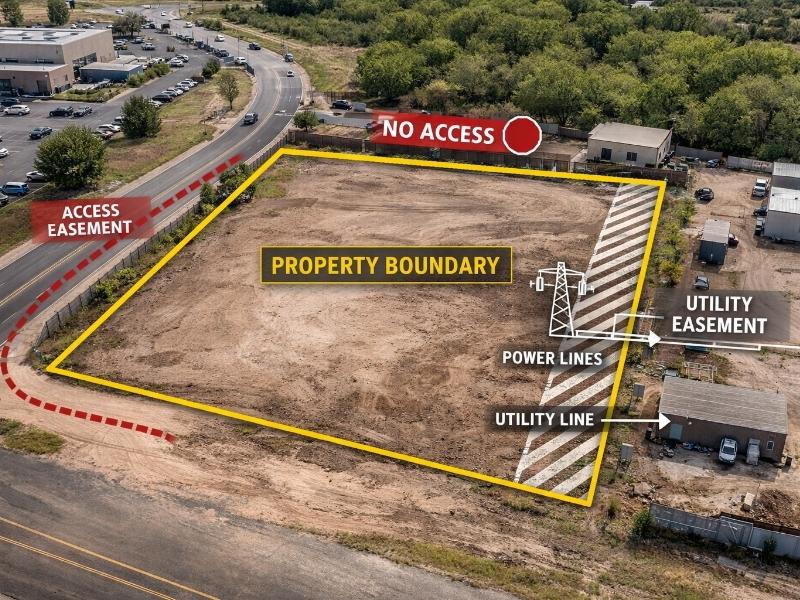
Aerial view of a property showing easements, property boundaries, utility lines, and access restrictions across a development site

If you’ve ever bought land and assumed you had full control over every inch of it, you may want to sit down. Understanding easements before purchasing or developing land can help you avoid costly surprises because they can quietly limit what you build and how you use your property. They don’t always show up in plain sight. And by the time most developers find out about them, the damage is already done.

What Is an Easement?

An easement gives another party the legal right to use a portion of your property for a specific purpose. That party could be a utility company, a neighbor, a government agency, or even the general public.

You still own the land. But your ownership comes with strings attached.

Easements run with the land. That means they transfer automatically when a property is sold. You can’t negotiate one away just by buying the lot.

Types of Easements You’ll Encounter 

Utility Easements

These are the most common type in Daphne and surrounding areas. Power companies, water authorities and telecom providers often hold recorded rights to access a strip of your land for lines, pipes or equipment. You cannot build a structure over that strip.

If you try, you’ll be asked to remove it. At your own expense.

Access Easements

When a neighboring parcel has no direct road frontage, the owner may hold a legal right to cross your property to reach a public road. This is called an access easement or a right-of-way.

Before you fence off any portion of your lot, confirm there’s no recorded access easement running through it.

Drainage Easements

Baldwin County gets significant rainfall. Drainage easements protect designated flow paths for stormwater across private land. Building over one puts you in conflict with both the county and your neighbors downstream.

Prescriptive Easements

This one catches developers off guard. Under Alabama law, if someone has openly used a portion of your property for 20 continuous years without your permission, they may have a legal right to keep doing so.

You don’t have to sign anything. You don’t have to agree. If the use has been open, continuous and uninterrupted long enough, a court can recognize it as a legal easement.

Conservation Easements

A prior owner may have voluntarily agreed to restrict development on the property in exchange for tax benefits. That restriction follows the deed. If you buy land with a conservation easement attached, those restrictions are now yours to deal with.

How Easements Are Created

They don’t appear by accident, but they can form in ways that aren’t obvious in a basic title search. Common sources include:

  • Deed language recorded at the time of sale
  • Separate documents filed with the Baldwin County Probate Court
  • Court orders following property disputes
  • Long-term open use by a neighbor or the public (prescriptive)
  • Voluntary agreements with conservation organizations

The ones recorded with the probate court are findable. The prescriptive ones are not always visible in public records

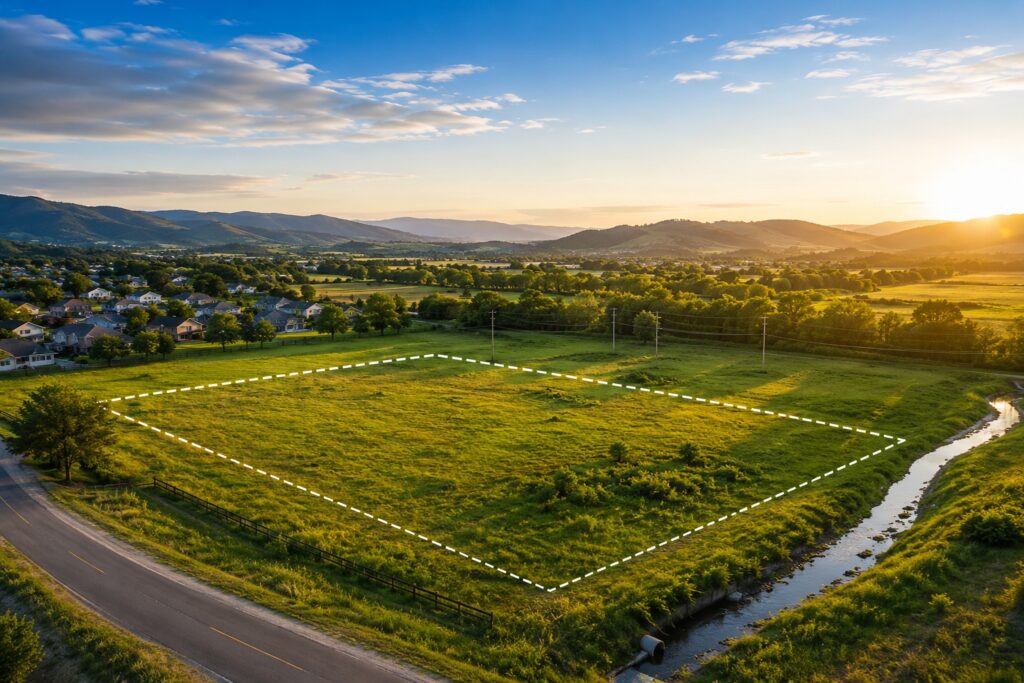
Aerial view of an undeveloped property parcel illustrating easements, access rights, and land development considerations

What Easements Mean When You’re Building

A utility easement running diagonally across a residential lot can eliminate your preferred building footprint entirely. A drainage easement near the rear setback might push your structure 10 to 15 feet further forward than you planned.

Finding this out during site plan review costs time. Finding it out after grading has started costs money. Finding it out after you’ve poured a foundation costs a great deal more than either.

A boundary and easement survey, completed before you finalize your site plan, shows you exactly where recorded easements fall on the ground. Not just described in a deed. Staked out on the actual lot.

That’s the difference between planning on solid ground and replanning under pressure.

Can You Remove an Easement?

Yes. But it takes work. The most common paths include:

  • By agreement: Both parties sign a recorded release document.
  • By abandonment: The easement holder stops using it and demonstrates no intent to resume.
  • By merger: You acquire the property that benefits from the easement, combining both parcels under one owner.
  • By court order: A judge rules the easement is no longer valid.

In Alabama, removing an easement almost always requires an attorney. A new survey documenting the change on the ground is often required before any release is recorded.

What Happens If You Build Over an Easement

Don’t.

If you place a structure, a fence or a retaining wall over an easement without written consent from the holder, you can be ordered to remove it. That includes finished construction. Alabama courts have sided with easement holders in these disputes consistently.

Some utility companies hold blanket rights to remove anything within their easement corridor. No prior notice. No reimbursement.

How to Find Easements Before You Close

Use this checklist on every parcel before signing anything:

  1. Order a title search through a licensed Alabama title company.
  2. Review the deed for any easement language in the legal description.
  3. Pull recorded documents from the Baldwin County Probate Court.
  4. Commission a boundary and easement survey from a licensed land surveyor.
  5. Walk the property. Look for utility infrastructure, worn paths or drainage channels that suggest regular use.

A title search and a land survey work together. One tells you what’s recorded. The other tells you where it actually sits on your lot.

Frequently Asked Questions

Do easements affect property value? 

They can. An easement that runs through a buildable area reduces usable square footage. That affects what you can develop and what a lender will say about the land’s value. Conservation easements may reduce assessed value, which can lower property taxes but also limits future use.

Can I build a fence inside an easement area?

It depends on the recorded terms. Some easements allow fencing as long as you provide access when the holder needs it. Others prohibit any physical barrier. Read the actual recorded document before you put it in a post.

Are easements permanent? 

Most are, unless the document includes an expiration date or the holder formally releases the right. Utility and prescriptive easements in Alabama are typically permanent once established.

Does a land survey show all easements? 

A boundary survey by a licensed surveyor will show recorded easements. It may not reveal prescriptive easements that were never filed with the court. Pair any survey with a title search for the most complete picture.

Who maintains an easement area? 

The easement holder is generally responsible for the area they use and access. The property owner is responsible for the surrounding land. The recorded document usually defines this. If yours doesn’t, an attorney can help clarify.

Posted in land surveying | Tagged easements, Land Surveying

Post navigation

← Older posts
Newer posts →

Contact Us Now

    Categories

    • alta survey
    • blog
    • elevation certificate
    • flooding
    • GPS
    • land surveying
    • land surveyor
    © Copyright Daphne Land Surveying
    Daphne, Alabama 36526
    Phone: (251) 270-4140

    Privacy Policy | Terms of Use

    Web Development and SEO by:
    AuburnBusiness.com

    The owner of this website, USA Surveying & Engineering, LLC., provides coordination of professional land surveying and engineering services in all 50 states. The professional surveying and engineering services provided to you will be conducted by fully licensed professionals in your state.

    Privacy Policy
    ↑